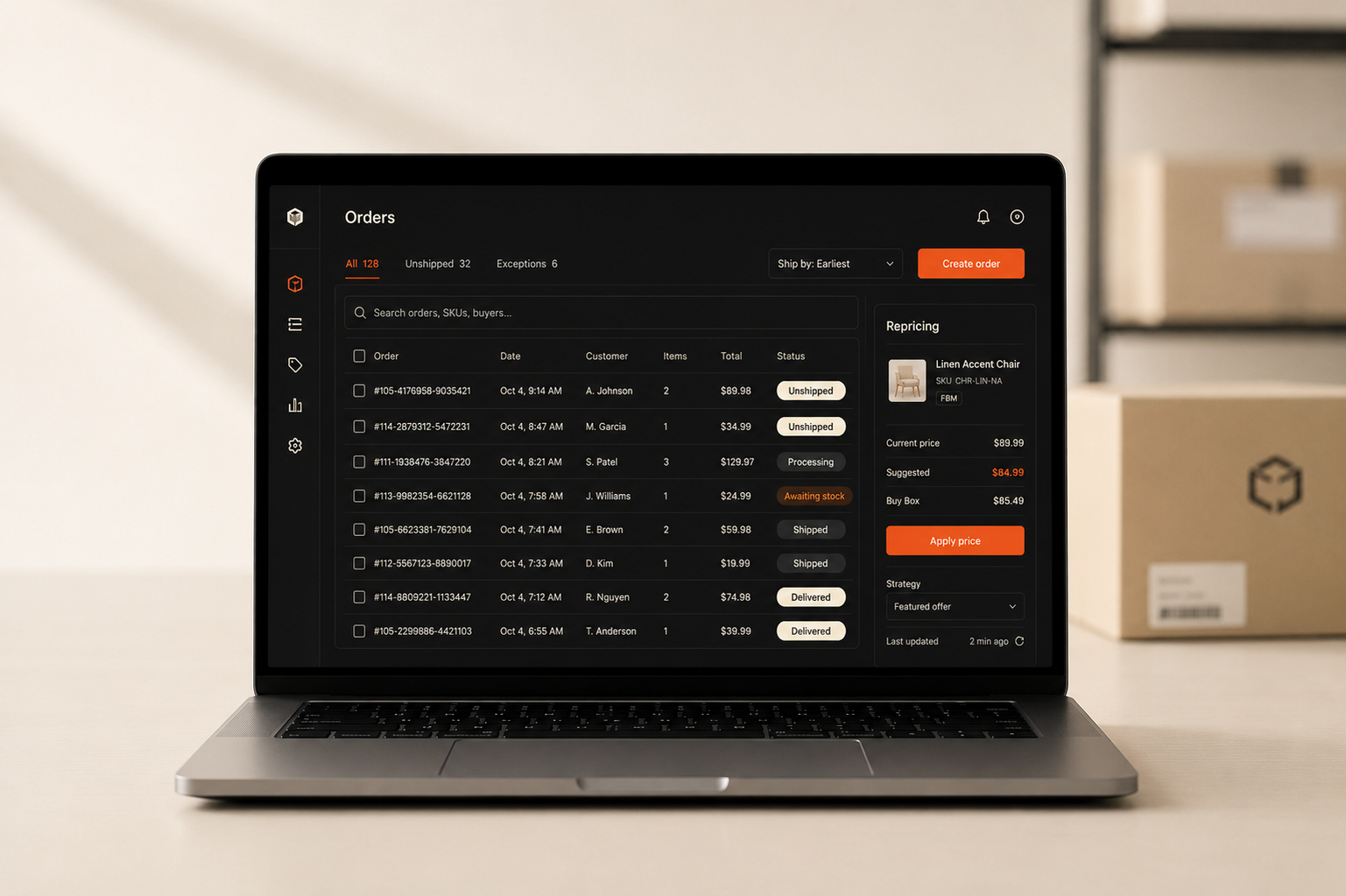
An internal dashboard that wraps the Amazon Selling Partner API end-to-end — orders, inventory, repricing, listings, and reporting — so the ops team runs the entire business in one place and never logs into Seller Central.

Running an Amazon business at scale meant a dozen people, all day, inside Seller Central — slow, clunky, one marketplace at a time, with no shared view and no automation. Repricing was manual. Reports were exported by hand. Returns slipped through the cracks.
The brief: build an in-house console on top of the Selling Partner API that does everything Seller Central does — only faster, unified across marketplaces, and automated where it counts. The goal was simple: the team should never need to open Amazon's dashboard again.
FBA, FBM, and merchant-fulfilled orders stream into a single board via the SP-API Orders & Feeds endpoints. Ship, refund, message the buyer, and handle returns — without ever opening Seller Central, across every marketplace at once.
Stock syncs in real time; a BullMQ job queue on Redis reprices listings every few minutes against Buy-Box rules. Win-rate is tracked per SKU, and the whole engine respects SP-API rate limits with backoff and retries.
Settlement reports, fee breakdowns, and P&L are fetched, normalized, and cached in MongoDB — so finance gets instant, exportable numbers instead of waiting on Amazon's report queue and stitching CSVs by hand.
Our team used to live in Seller Central across six tabs. Now they don't open it at all — everything's in Helm, and it's faster than Amazon's own dashboard.
Orders, inventory, listings, pricing, reports, notifications, returns, messaging and more — unified into a single console the whole team shares.
Streamed through the SP-API pipeline with rate-limit-aware queues — no dropped events, no manual exports, across six marketplaces.
The metric that mattered: the ops team runs the entire business inside Helm. Amazon's own dashboard became a fallback they never reach for.
Orders, inventory, and settlement — every Amazon SP-API data stream in a single internal console.